
 "/>
"/>
"/>
"/>


非标社区的“新未来主义”
Neo-Futurism of a Non-Standard Community
成都海耀作为建发房产西南“灯塔战略”的首个落地项目,是正象设计对未来人居原型的一次重要探索。这一项目的诞生根植于当前中国房地产市场转型的宏观语境之下,其历程本身便是对时代命题的积极回应与先行实践:它不仅是“未来森境”理念的具象实践,也是一次基于城市文化洞察的非标定制创作。
本文旨在记录一座“新未来主义社区”从概念到建成的完整过程,呈现“未来城市样本”如何在复杂协同中实现可持续生长,并探寻建筑在当下行业深度调整与价值重构的背景下,属于当代中国的表达方式。
As the first completed project under C&D Property’s “Lighthouse Strategy” in Southwest China, Chengdu Grand Mansion represents a significant exploration by ZEN into future residential prototypes. Rooted in the broader context of China’s ongoing real estate transformation, the project itself constitutes an active response to—and an early practice of—the challenges of its time. It is not only a concrete embodiment of the “Future Forest Habitat” concept, but also a non-standard, site-specific creation grounded in deep urban and cultural insight.
The project documents the full trajectory of a neo-futurist residential community—from conceptual vision to realized urban organism—examining how architecture can reconcile high-density development with environmental integration, experiential richness, and long-term adaptability. Rather than pursuing iconic form, Chengdu Grand Mansion reflects on how architecture in contemporary China can articulate new values through lived experience.
有机社区的“新未来主义”
Neo-Futurism of the Organic Community
正象设计根植于整个成都市的城市肌理与发展脉络,在“高密度复合社区High-density Mixed-use Community”领域有着持续生长的洞察与实践迭代:建筑不再是形而上的容器,而是与自然对话、与城市共生的有机生命体。这一设计思想的源头,正是城市自然系统给予的启发,我们以“使用者真实习惯”为核心洞察,致力于构建多重感官的全维度场景体验。
Rooted in Chengdu’s urban fabric and developmental trajectory, ZEN has continuously cultivated insight and iterative practice within the field of high-density mixed-use communities. Here, architecture is no longer conceived as an abstract container, but as an organic living entity—one that dialogues with nature and coexists symbiotically with the city. This design philosophy originates from the inspiration offered by urban natural systems. Centered on an understanding of real user behavior, the project seeks to construct a full-spectrum, multi-sensory spatial experience.
有机生命体——自然系统重构城市秩序
An Organic Organism — Reconstructing Urban Order through Natural Systems
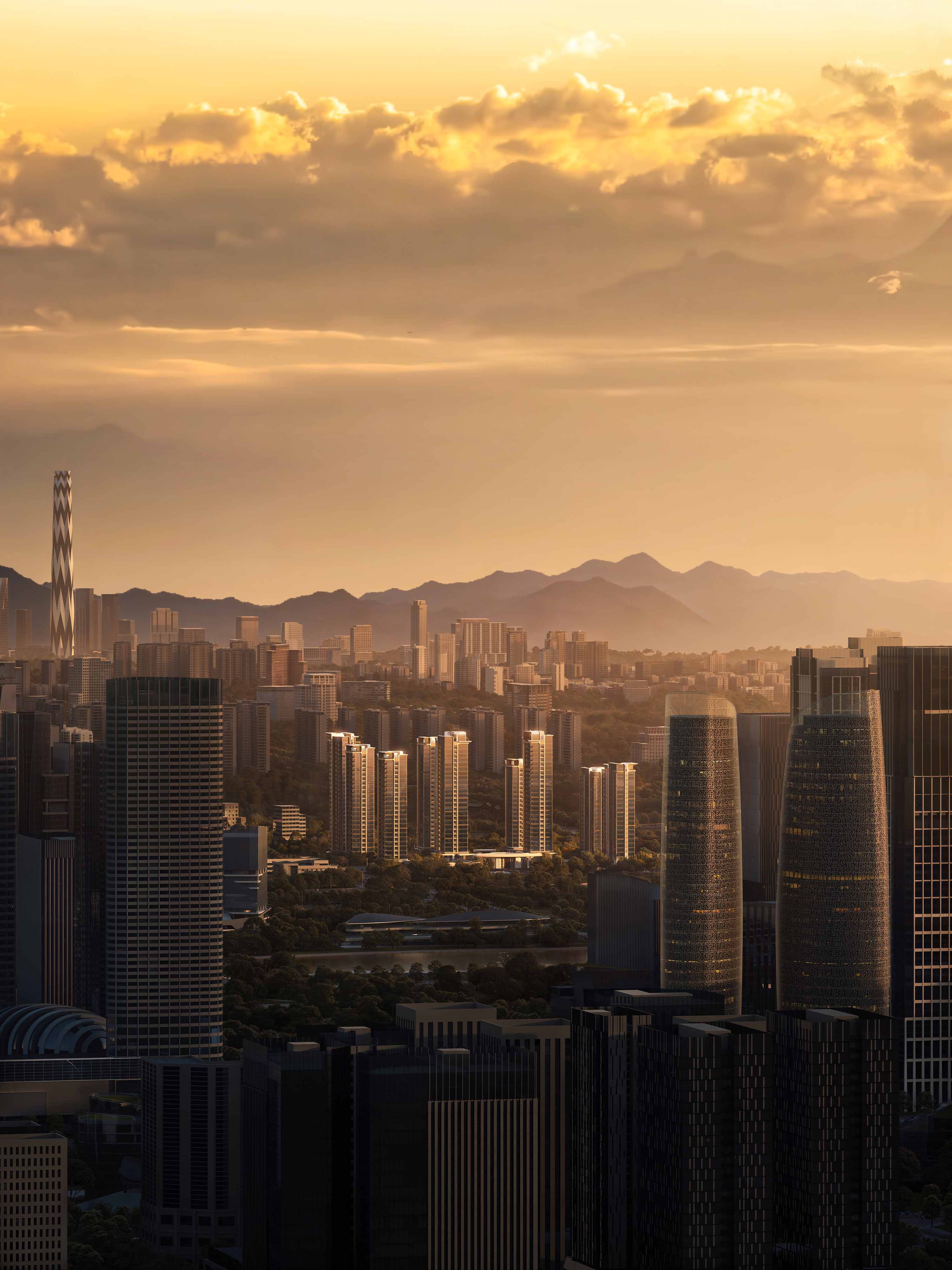
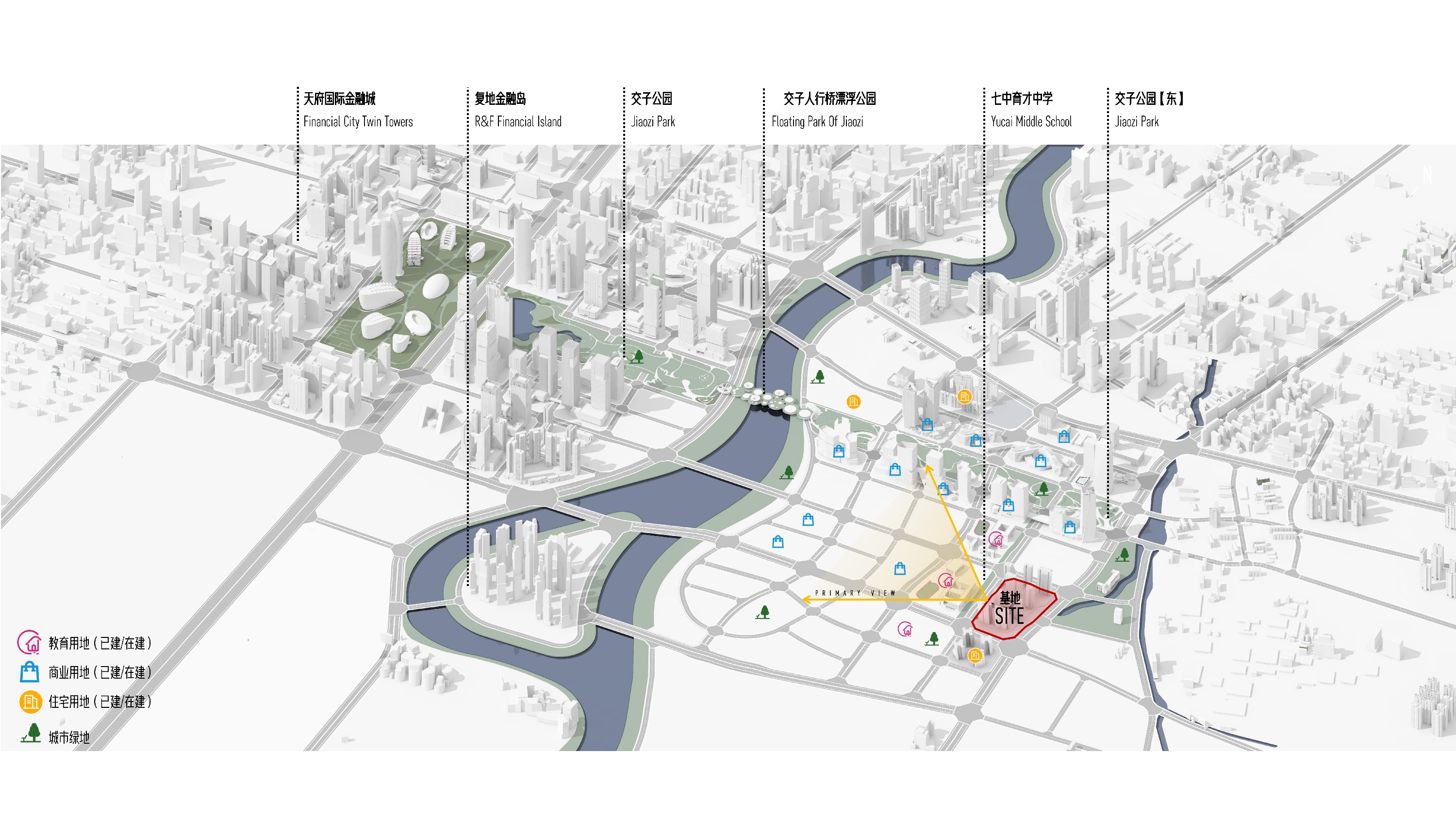
在成都金融城三期的规划蓝图中,交子公园与锦江绿道构成了城市自然的生态中轴,与超220万㎡产业空间、超60万㎡商业体量共同形成复合的城市系统。以交子云塔等地标为天际线焦点,这里将实现商业场景与公园水岸的无缝衔接,让办公、居住、文化与休闲在时间与空间中自由交织,形成一座持续活跃的“全景生活场”。
作为金融城三期的重要节点,建发·海耀不仅是建发房产西南“灯塔战略”的开篇之作,更承载着城市、自然与建筑三者融合共生的使命。面对重要地标项目的委托任务,如何在极限压力下与时间赛跑,也要探索更高阶设计标准的边界,这都是本项目面临的挑战。
正象设计以此为着力点,基于对城市发展脉络的深度洞察与实践,从“景城融合”的规划理念出发,逐步深化为“全景生活”的人居实践,为未来的城市生活打造一个可感知、可持续、可生长的人居范本。
在规划设计方面,我们以“自然系统引导设计逻辑”为原点,将交子公园的景观渗透、锦江水岸的生态调节以及区域日照与风环境等要素转化为空间组织的基本参数。设计过程并非形式驱动的意象塑造,而是基于未来使用者真实生活场景的“感官地图”——通过回归居住本质的行为模拟,避免异形化的空间与视线冲突,构建出视觉舒适、行为连贯的场所体验。
整体采用全点式塔楼正南北向体系,以规整的楼型逻辑、近50米宽幅的塔楼间距与功能复合的超级公共底盘,形成有序的空间结构。这一策略既是对基地自然语境的理性回应,也是对高密度城区中“呼吸感”与“通达性”的转译。
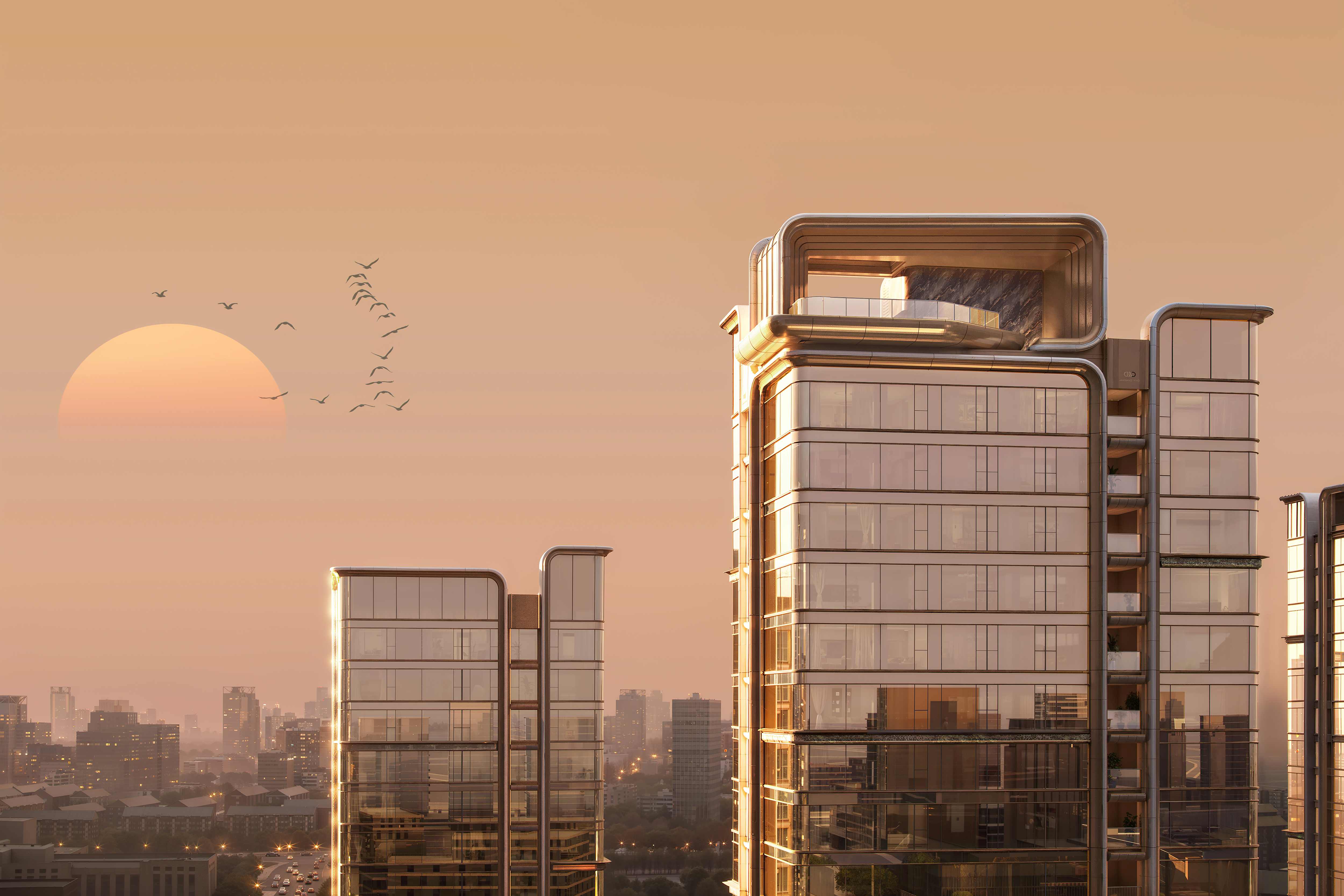
西侧城市界面通过退让与留白,形成柔性的过渡空间,在塑造标志性形象的同时,有效降低街道压迫感。西侧五栋塔楼以错位布局与高度梯度,构筑起面向交子云塔的连续性视觉通廊,整体形成具有动态韵律的天际线。这不仅在平面上实现了与自然渗透的对话,更在垂直维度上构筑了空间层次与流动性,使建筑群落如有机生命体一般,既融入城市肌理,又焕发自然生长的内在秩序。
Within the planning vision of Chengdu Financial City Phase III, Jiaozi Park and the Jinjiang Greenway form an ecological spine for the city, integrated with over 2.2 million m² of industrial space and 600,000 m² of commercial programs into a complex urban system. Anchored by landmarks such as Jiaozi Cloud Tower, the district enables seamless connections between commercial activities and park-side waterfronts, allowing work, living, culture, and leisure to interweave freely across time and space—shaping a continuously activated “panoramic living field.”
As a key node within Financial City Phase III, Chengdu Grand Mansion is not only the inaugural project of C&D Property’s Lighthouse Strategy in Southwest China, but also bears the mission of integrating city, nature, and architecture into a coherent whole. Confronted with the dual pressures of landmark-level expectations and compressed timelines, the project was challenged to explore the boundaries of elevated design standards under extreme conditions.
In response, ZEN anchored its approach in a profound understanding of urban development, evolving the planning concept of “city–landscape integration” into a lived practice of “panoramic living.” The project aspires to establish a perceptible, sustainable, and growth-oriented prototype for future urban habitation.
From a planning perspective, the design begins with natural systems as the guiding logic, translating landscape infiltration from Jiaozi Park, ecological regulation along the Jinjiang waterfront, and regional sunlight and wind conditions into fundamental parameters of spatial organization. Rather than being driven by formal imagery, the process is informed by a “sensory map” of future daily life—using behavioral simulation rooted in residential essence to avoid distorted forms and visual conflicts, and to create environments of visual comfort and behavioral continuity.
The overall layout adopts a point-tower system oriented strictly along the north–south axis. With rational tower typologies, nearly 50-meter-wide inter-tower spacing, and a multifunctional super public plinth, the scheme establishes a clear and ordered spatial structure. This strategy responds rationally to the site’s natural context while translating “breathability” and accessibility within a high-density urban environment.
Along the western urban interface, strategic setbacks and voids create a soft transitional zone, shaping a distinctive identity while mitigating street-level pressure. Five west-facing towers are staggered in plan and height, forming a continuous visual corridor toward Jiaozi Cloud Tower and generating a dynamic skyline rhythm. This configuration facilitates dialogue with natural infiltration at the horizontal level, while vertically constructing layered spatial depth and fluidity—allowing the architectural ensemble to function as an organic organism that both integrates into the urban fabric and expresses an intrinsic order of natural growth.
超级底盘的“新未来主义”
Neo-Futurism of the Super Plinth
伯纳德·屈米(Bernard Tschumi)在《建筑与分离》中提出的观点——建筑不仅是功能的容器,更是事件与体验的催化剂。正象设计通过该项目中“超级底盘的叙事性重构”,提出一种基于当代生活的“新未来主义”空间观,引导人在与环境的多维互动中,形成更具能动性与诗意的“在场感”。
Bernard Tschumi, in Architecture and Disjunction, argues that architecture is not merely a container of function, but a catalyst for events and experiences. Through the narrative reconstruction of the super plinth in this project, ZEN proposes a contemporary Neo-Futurist spatial outlook—one that guides people toward a heightened sense of agency and poetic presence through multidimensional interaction with their environment.
几何叙事——空间关系与体验的组织逻辑
Geometric Narrative — Organizing Spatial Relationships and Experience
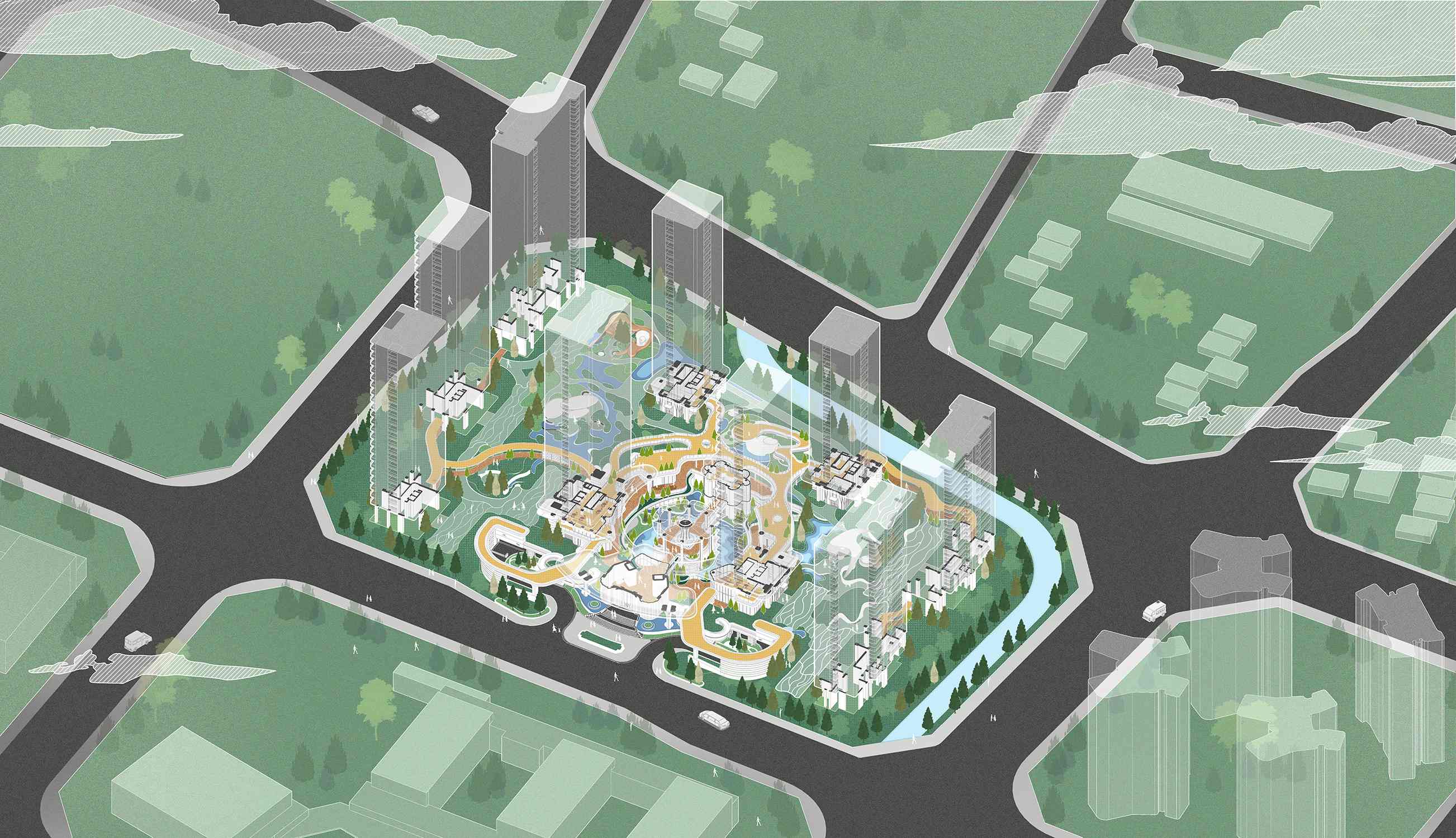
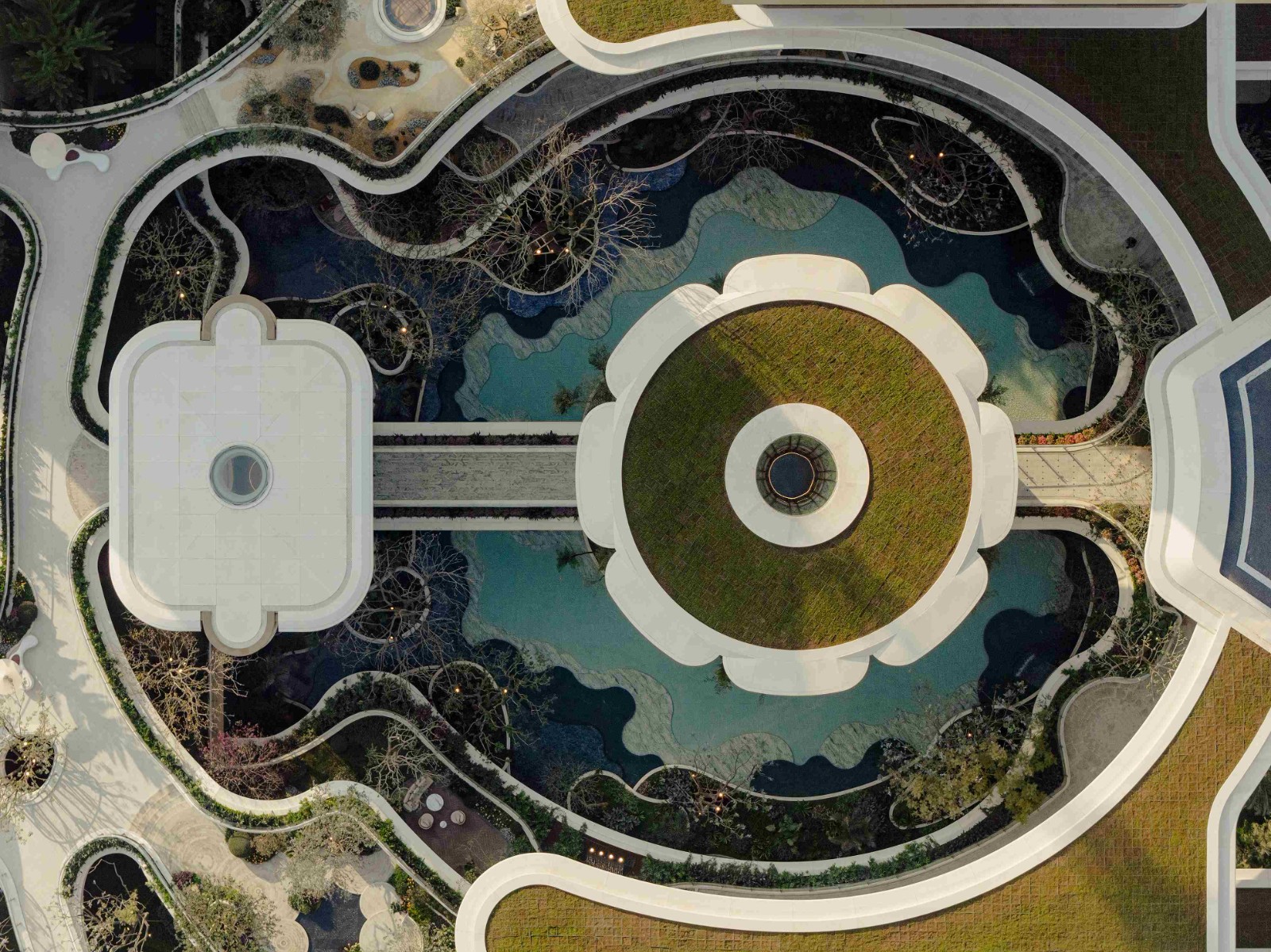
从成都历史脉络与场地“一轴一环”的空间结构中,我们提取出“超级底盘”的几何叙事原型。这一系统从二维平面网格发展为与地形深度融合的三维立体架构,形成承载流动场景的空间基底。
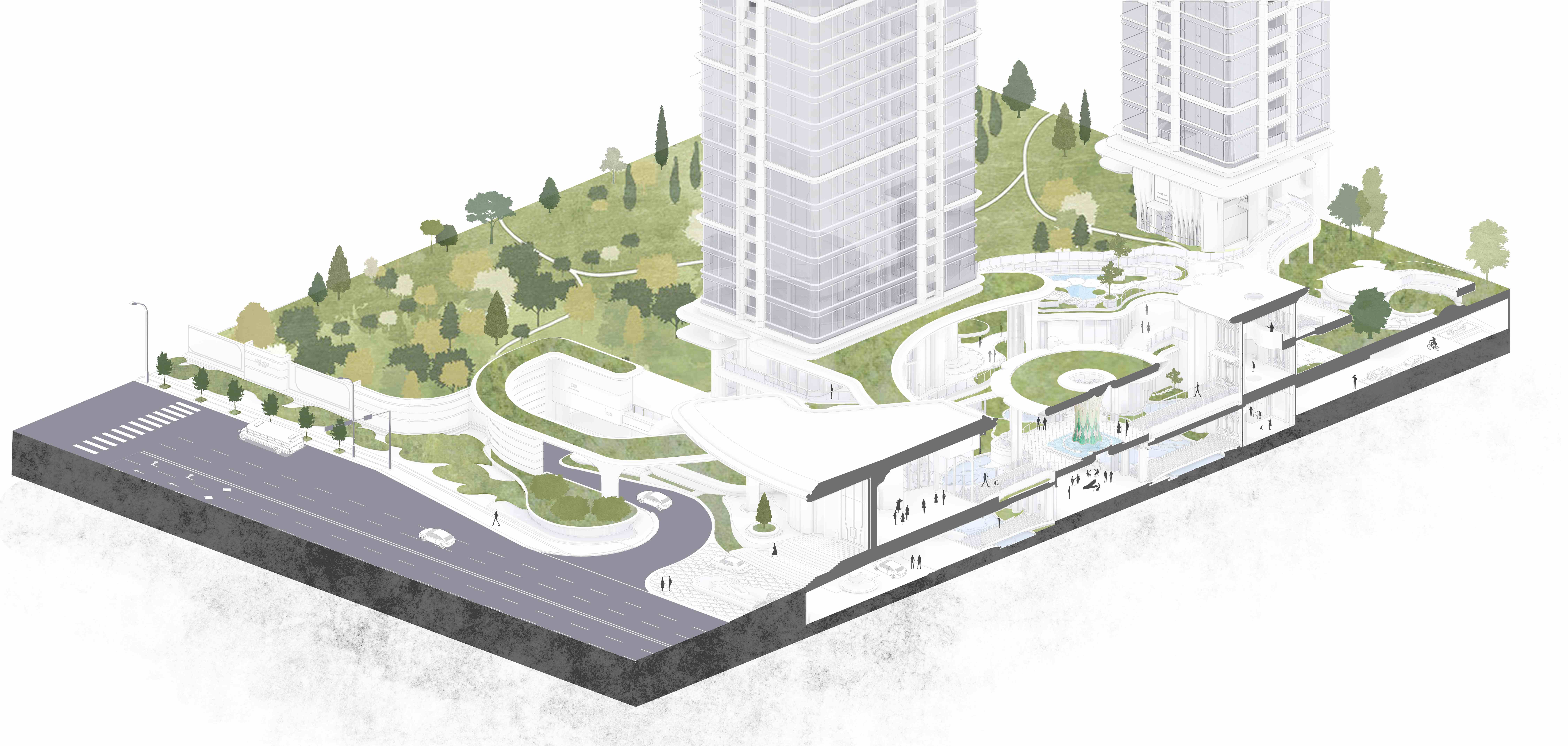
底盘以全架空12.9米的尺度,构建起双层连廊系统,串联多向路径、坡道与立体交通节点,引导使用者在探索中感知空间的层次与延伸。塔楼集约布局释放出的空间,转化为具有公共属性的漫游场所。
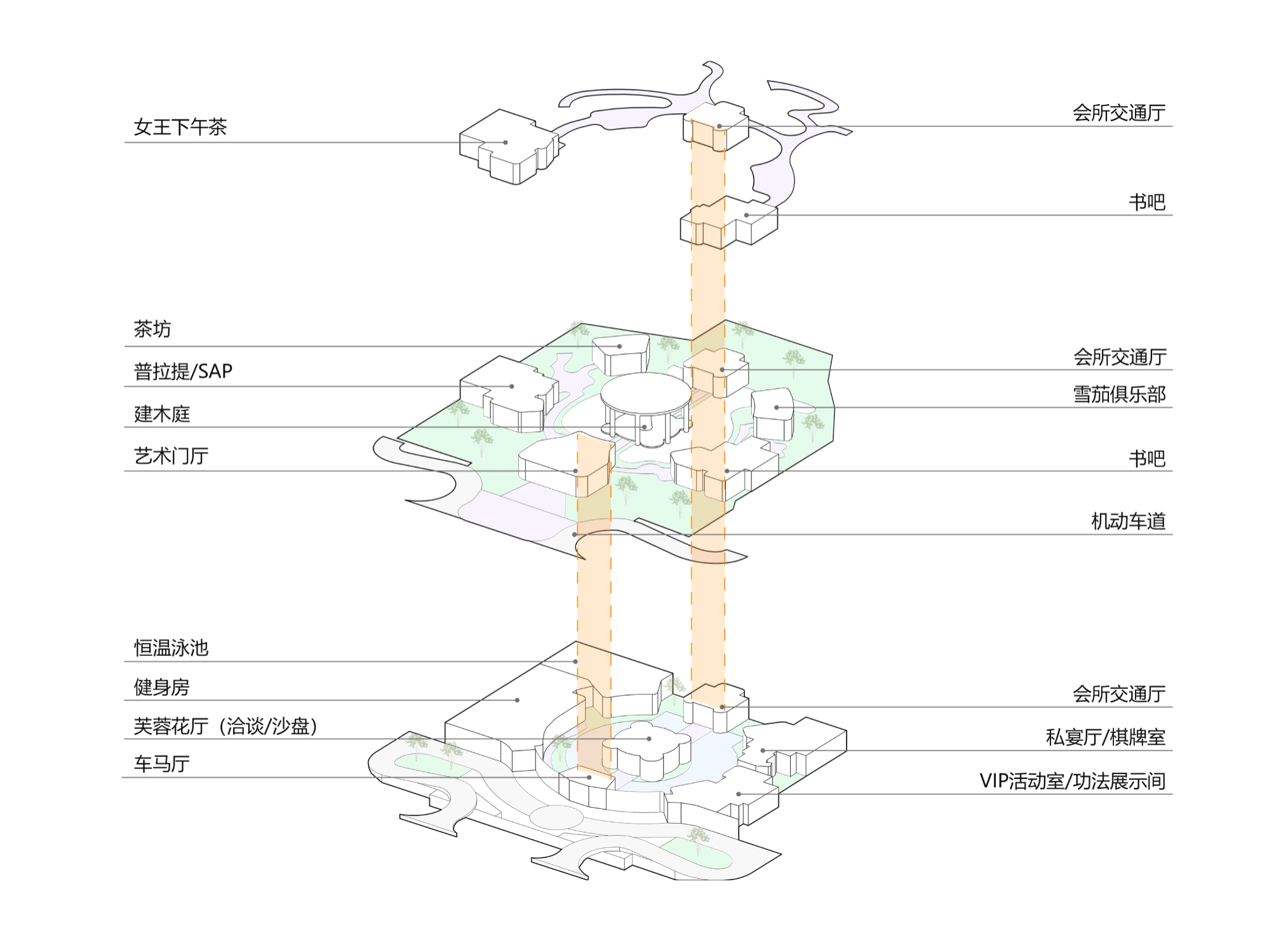
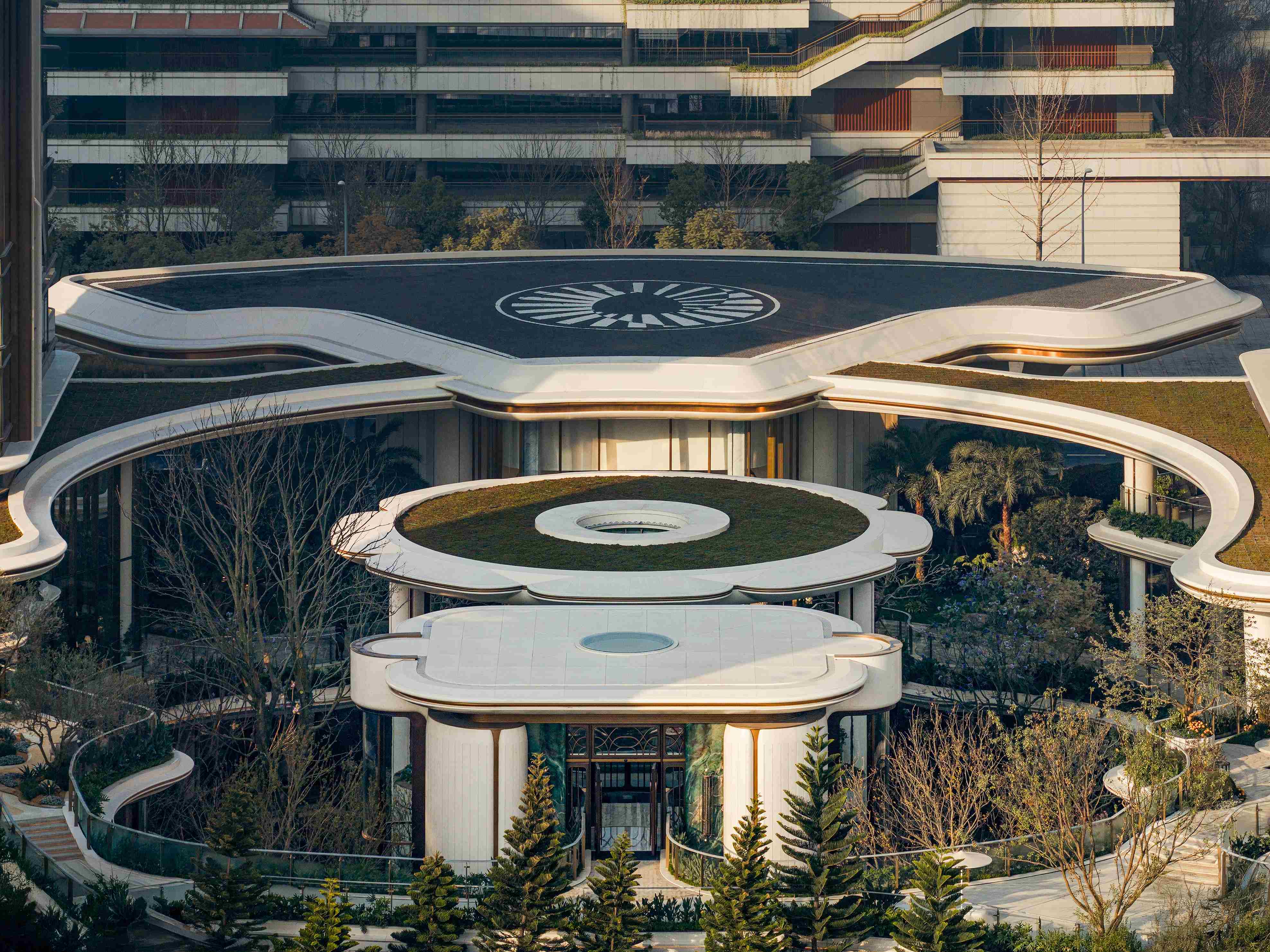
归家仪式的空间叙事始于超尺度的几何形入口,经由艺术化门厅的序列过渡,最终聚焦于极具视觉张力的精神堡垒。这一核心体量作为空间叙事的中轴,凝结所有动线与视线,成为三层连廊环绕的视觉焦点,将人在场景中的体验与空间的结构逻辑紧密联系。
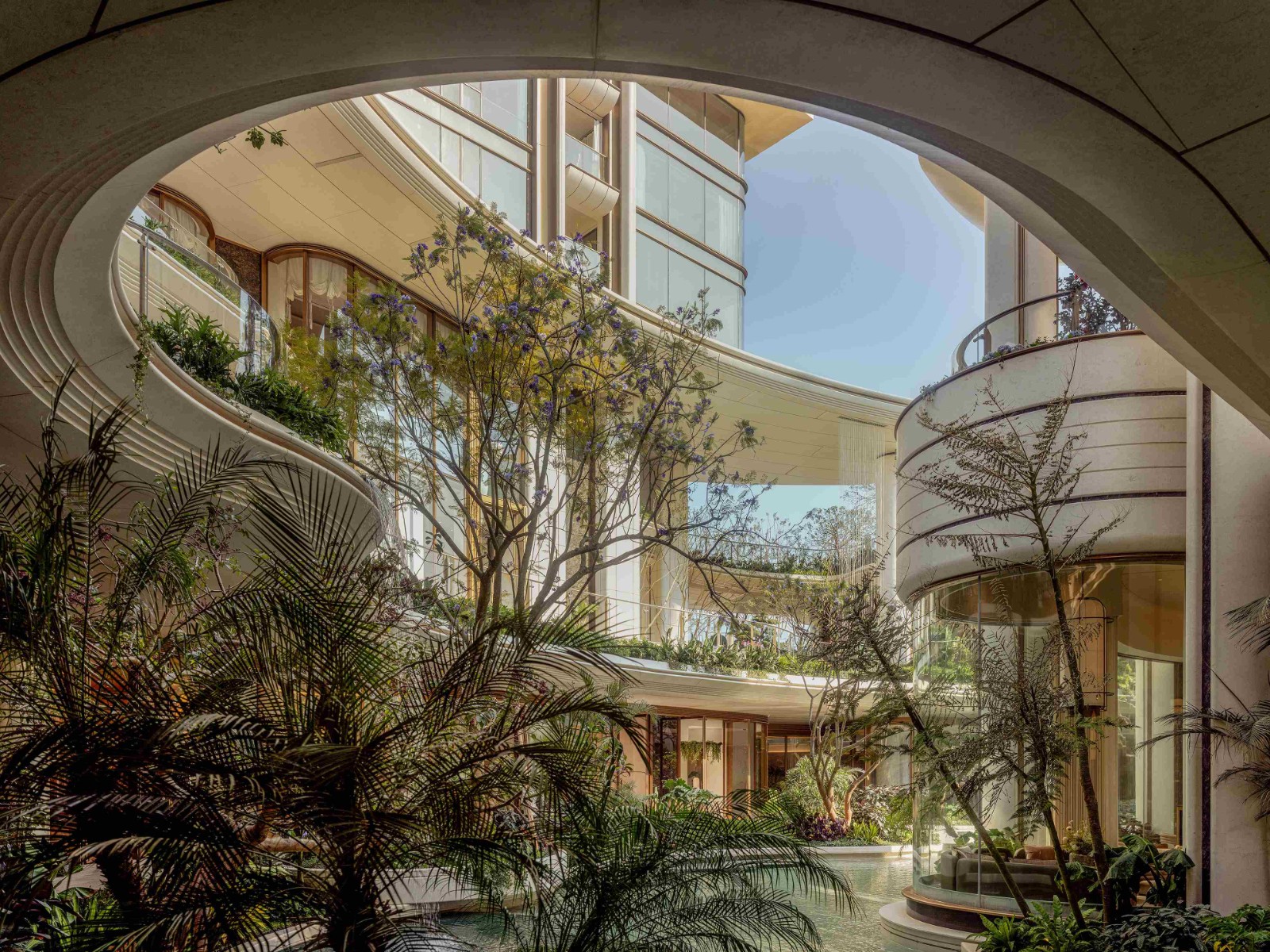
对称布局与自由曲线构成了基本的几何秩序,其中空间柱、弧形结构、曲线坡道、外挂胶囊电梯共同塑造出动态的漫游体验。这些设计元素超越了单一的功能性,走向艺术性与结构性的融合,也回应了约翰·波特曼在《Entelechy》系列中提出的建筑哲思——建筑应成为激发情感、连接自然、并最终升华生命体验的艺术装置。
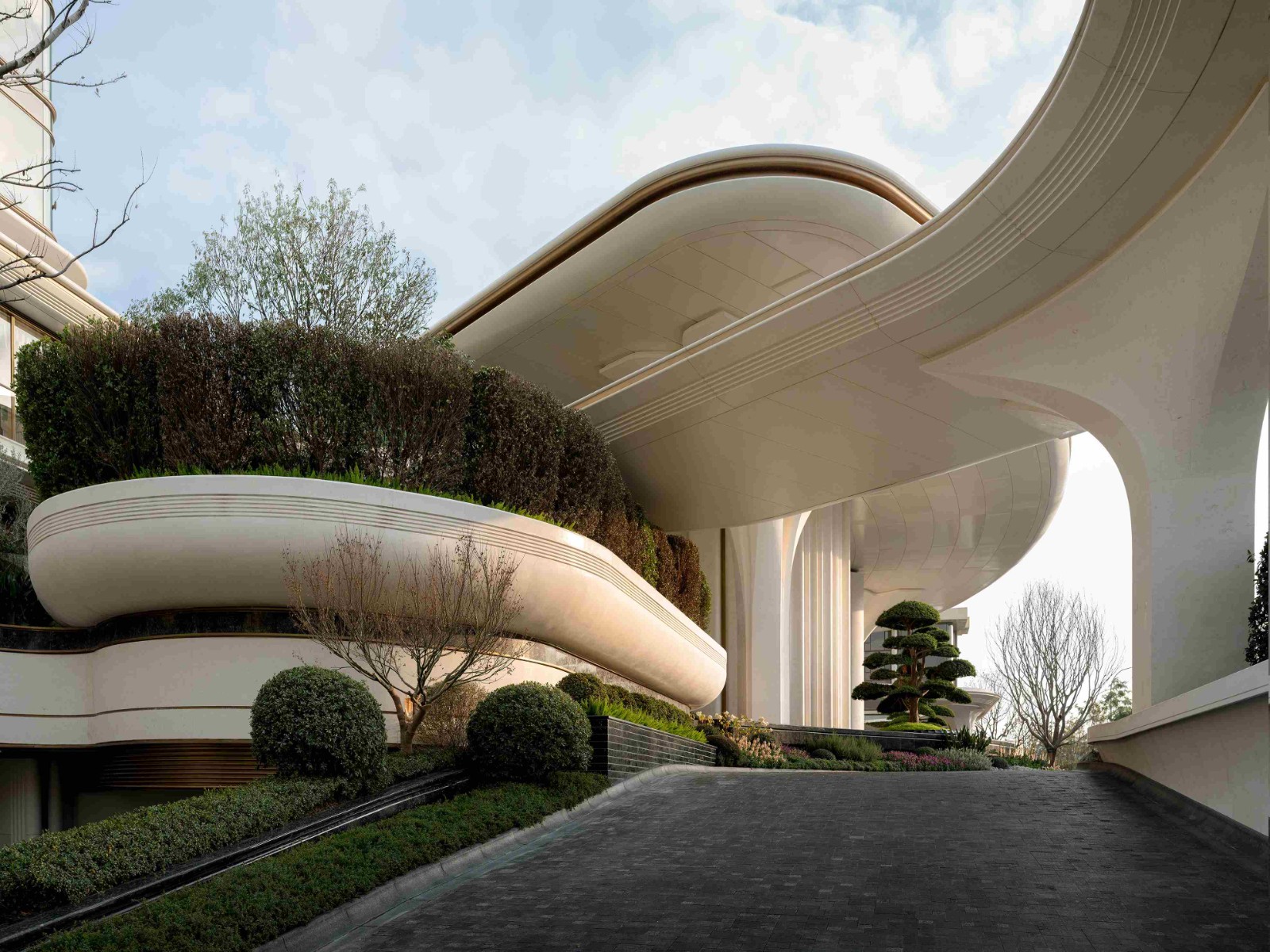
更加有趣的是,双层空中环廊与立体交通厅的无缝衔接,构建全天候归家路径,使用者可无风雨阻隔直达社区单元入口。车行坡道则通过独立环形动线,直达半开敞式停车库。这一立体交通系统实现了高效的人车分流,同时在移动中视线与场景持续流动,建筑立面、空间序列、景观层次随视点变化而重组。
Drawing from Chengdu’s historical context and the site’s “one axis, one ring” spatial structure, the design extracts a geometric narrative prototype for the super plinth. This system evolves from a two-dimensional planar grid into a three-dimensional structure deeply integrated with the terrain, forming a spatial base that supports fluid scenarios and movement.
Elevated entirely to 12.9 meters, the plinth establishes a dual-layered corridor system that connects multi-directional paths, ramps, and vertical circulation nodes, encouraging users to perceive spatial depth and extension through exploration. The compact tower arrangement liberates ground-level space, transforming it into publicly accessible promenades.
The spatial narrative of arrival begins at an oversized geometric entrance, transitions through a sequence of art-inflected lobbies, and ultimately converges on a visually striking spiritual bastion. Acting as the axial core of the entire narrative, this central volume gathers circulation and sightlines alike. Encircled by three levels of galleries, it becomes the visual anchor that tightly interweaves experiential perception with spatial structure.
A foundational geometric order emerges from the interplay between symmetry and free curves. Structural columns, arched forms, curvilinear ramps, and externally mounted capsule elevators collectively create a dynamic promenade experience. These elements transcend pure functionality, integrating artistry with structural expression, and echo John Portman’s architectural philosophy articulated in Entelechy—that architecture should function as an artistic apparatus capable of evoking emotion, connecting with nature, and ultimately elevating human experience.
Notably, the seamless integration of double-height sky corridors and vertical transportation halls establishes an all-weather return-home route, allowing residents to access their community units without exposure to wind or rain. Vehicular circulation follows an independent looped ramp system directly connected to semi-open parking areas. This three-dimensional traffic strategy ensures efficient separation of pedestrians and vehicles, while enabling continuously shifting visual relationships in motion—where façades, spatial sequences, and landscape layers are constantly reassembled through changing viewpoints.
知觉共创——多重感官潜能的释放
Perceptual Co-Creation — Releasing Multi-Sensory Potential
超级底盘的另外一大核心理念,在于构建“未来森境”这一沉浸式体验场域。正象设计认为,真正具有记忆性的空间并非被动接收预设的感官信息,而是让使用者释放多重感知的潜能。
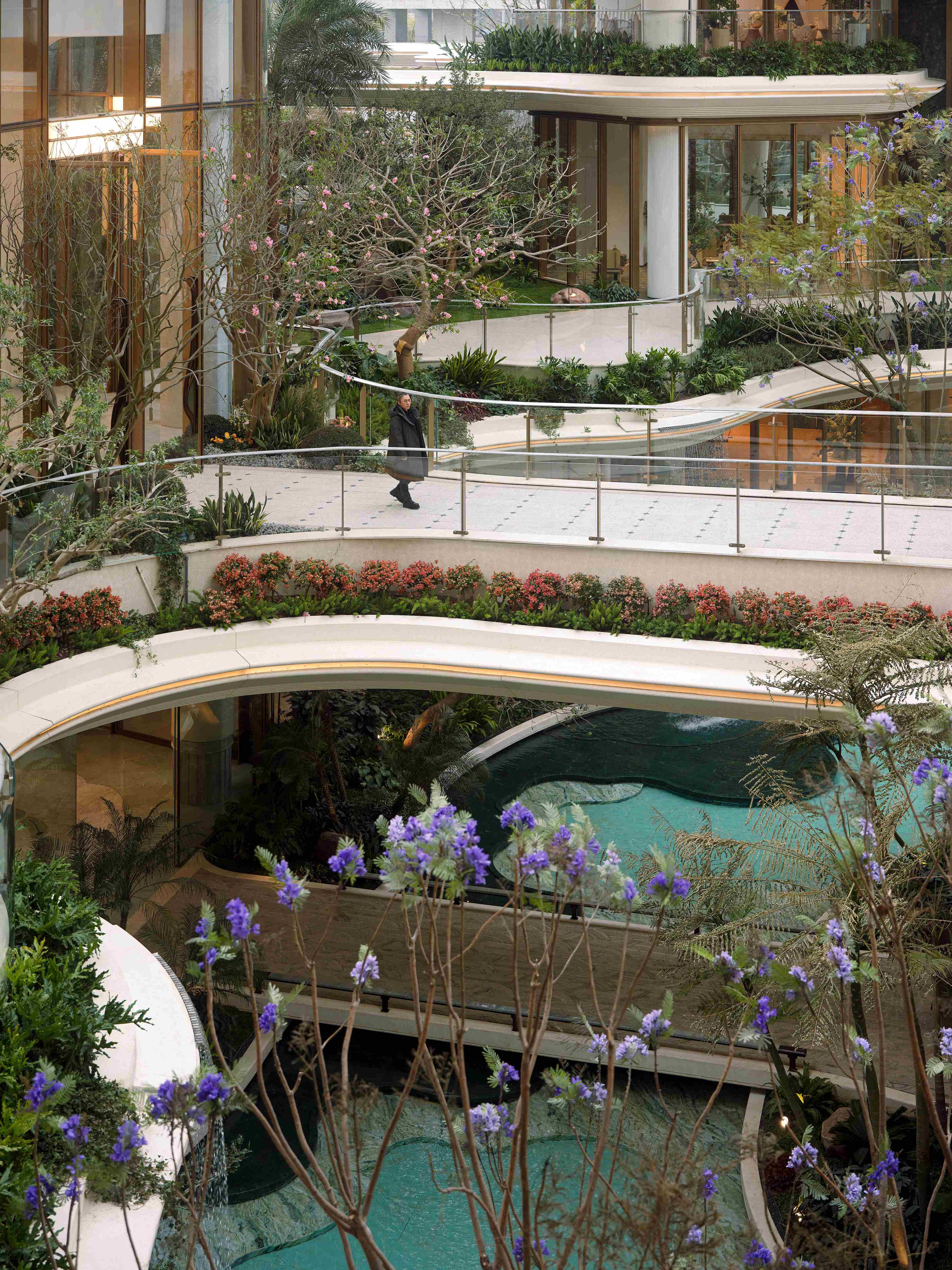
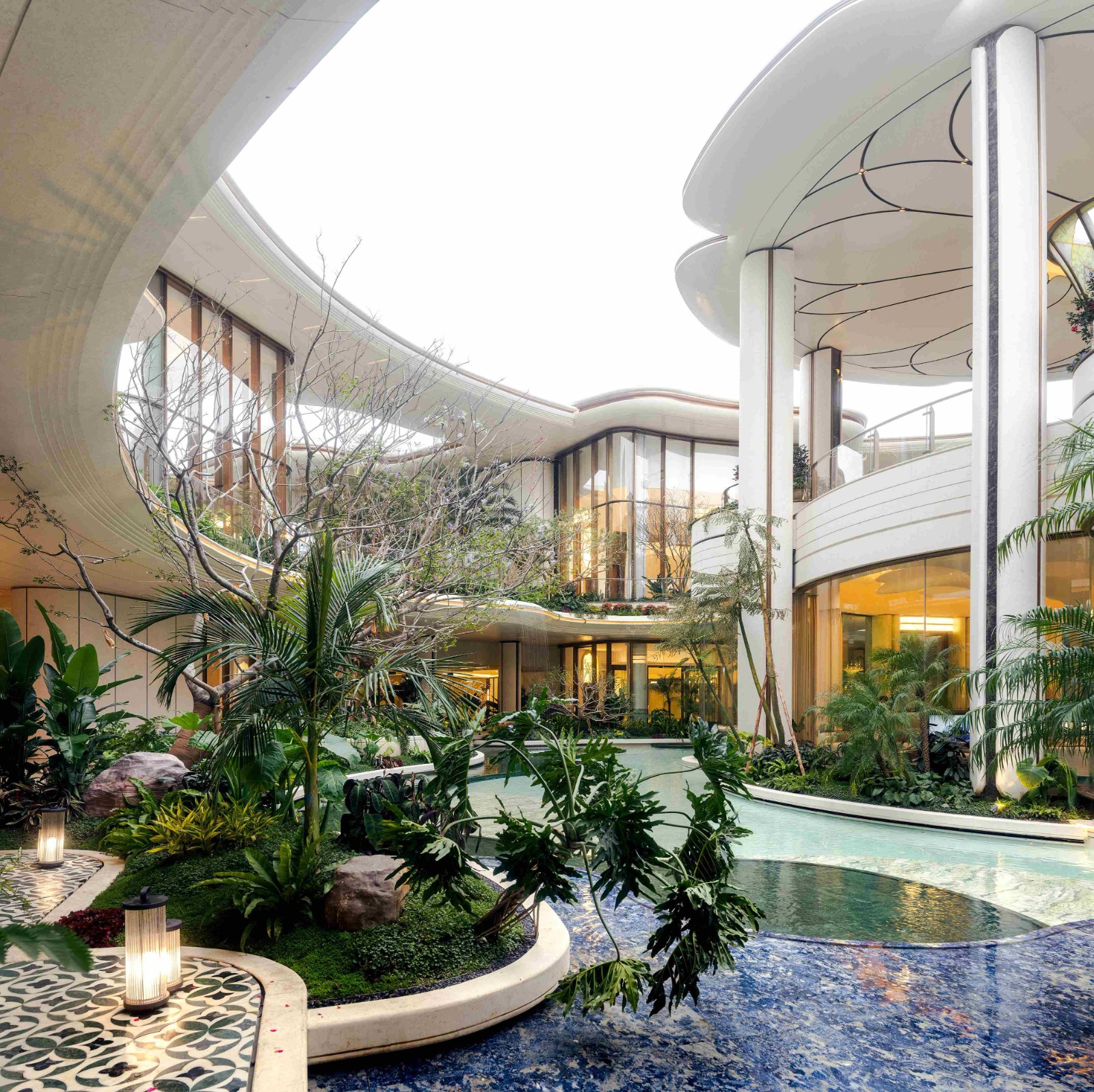
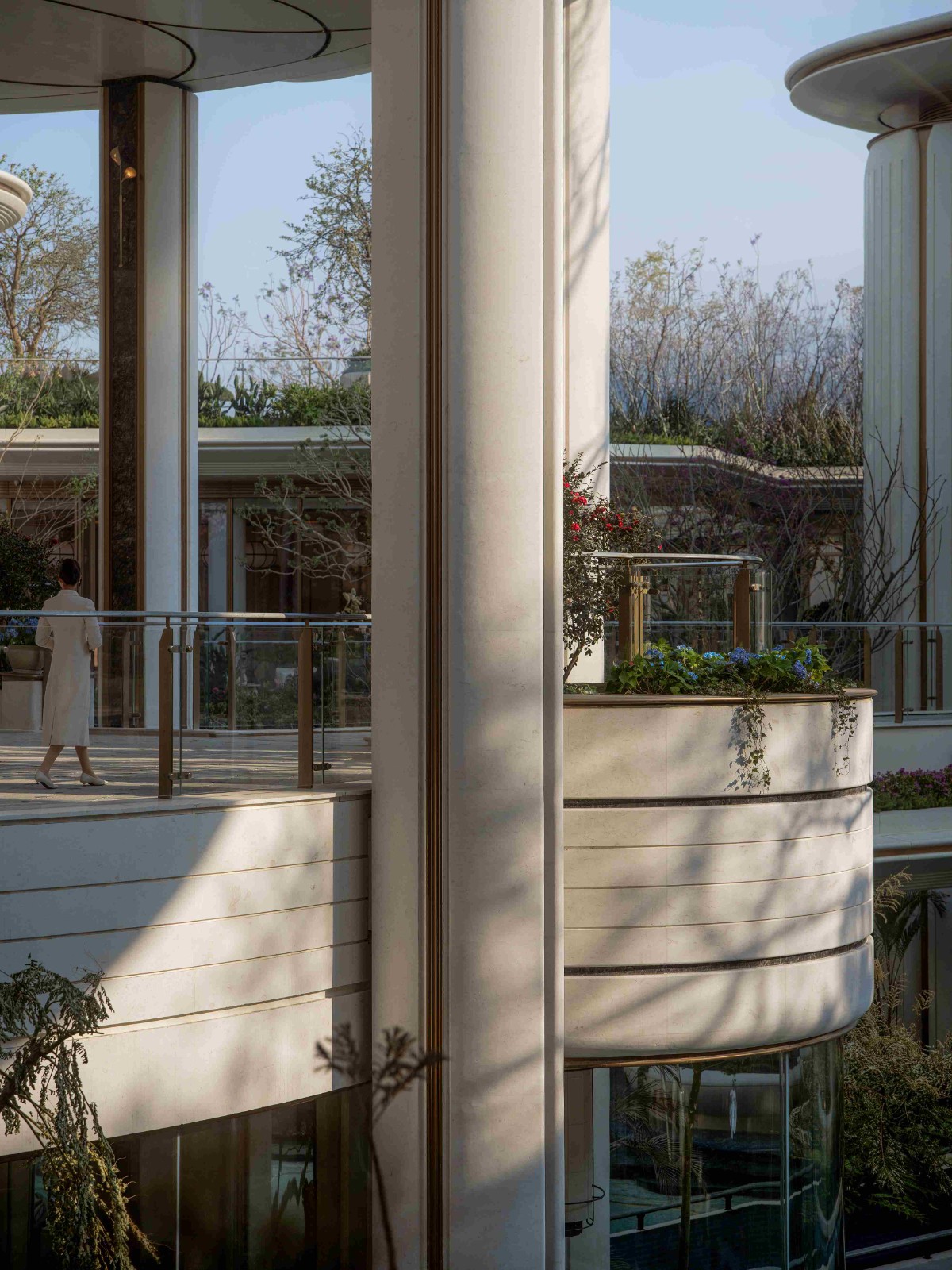
为此,设计通过三层总高18米的公共空间系统,串联起近20个主题各异的景观庭院与空中泛会所。这些立体花园以全玻璃幕墙消解内外边界,借助微型水景调节微气候,并通过庭院引入自然光影、水波与植被的动态切片,使建筑内部如同持续变化的“自然壁画”,让人在行走中不断与自然对话、与空间共创场所记忆。
其中,最具有代表性的精神堡垒空间“芙蓉花厅”,既是被观看的焦点,又是“事件舞台”,提供了一处瞭望场所,这种双向注视激活了公共空间的社交能量,也是对看与被看的空间关系的一种试验性探索。
Another core ambition of the super plinth lies in constructing the immersive experiential realm of the “Future Forest Habitat.” ZEN believes that truly memorable spaces are not those that passively deliver predetermined sensory stimuli, but those that invite users to activate their own perceptual potential.
To this end, a public spatial system spanning three levels and 18 meters in height links nearly 20 themed landscape courtyards with elevated communal lounges. Enclosed by full-height glass façades, these vertical gardens dissolve interior–exterior boundaries, regulate microclimates through water features, and introduce dynamic fragments of light, shadow, ripples, and vegetation. The interior thus becomes a continuously evolving “natural mural,” allowing people to engage in ongoing dialogue with nature and to co-create spatial memory through movement.
Among these spaces, the most emblematic is the Hibiscus Hall, conceived as a spiritual bastion. It functions simultaneously as a visual focal point and an “event stage,” offering an elevated lookout. This reciprocal relationship of seeing and being seen activates the social energy of the public realm and serves as an experimental exploration of spatial reciprocity.
艺术雕琢的“新未来主义”
Neo-Futurism Sculpted by Art
正象设计主张“体验至上”的整体设计哲学,将空间场景和人的感知编织成一个不可分割的网络。在这一体系中,艺术不再是建筑的附加装饰,既是激活感知的视觉锚点,也是升华空间精神性的关键媒介。
ZEN advocates a holistic design philosophy of “experience first,” weaving spatial scenarios and human perception into an inseparable network. Within this framework, art is no longer an ornamental supplement to architecture, but both a visual anchor that activates perception and a critical medium for elevating spatial spirituality.
非标美学——艺术作为建筑的平等伙伴
Non-Standard Aesthetics — Art as an Equal Partner of Architecture
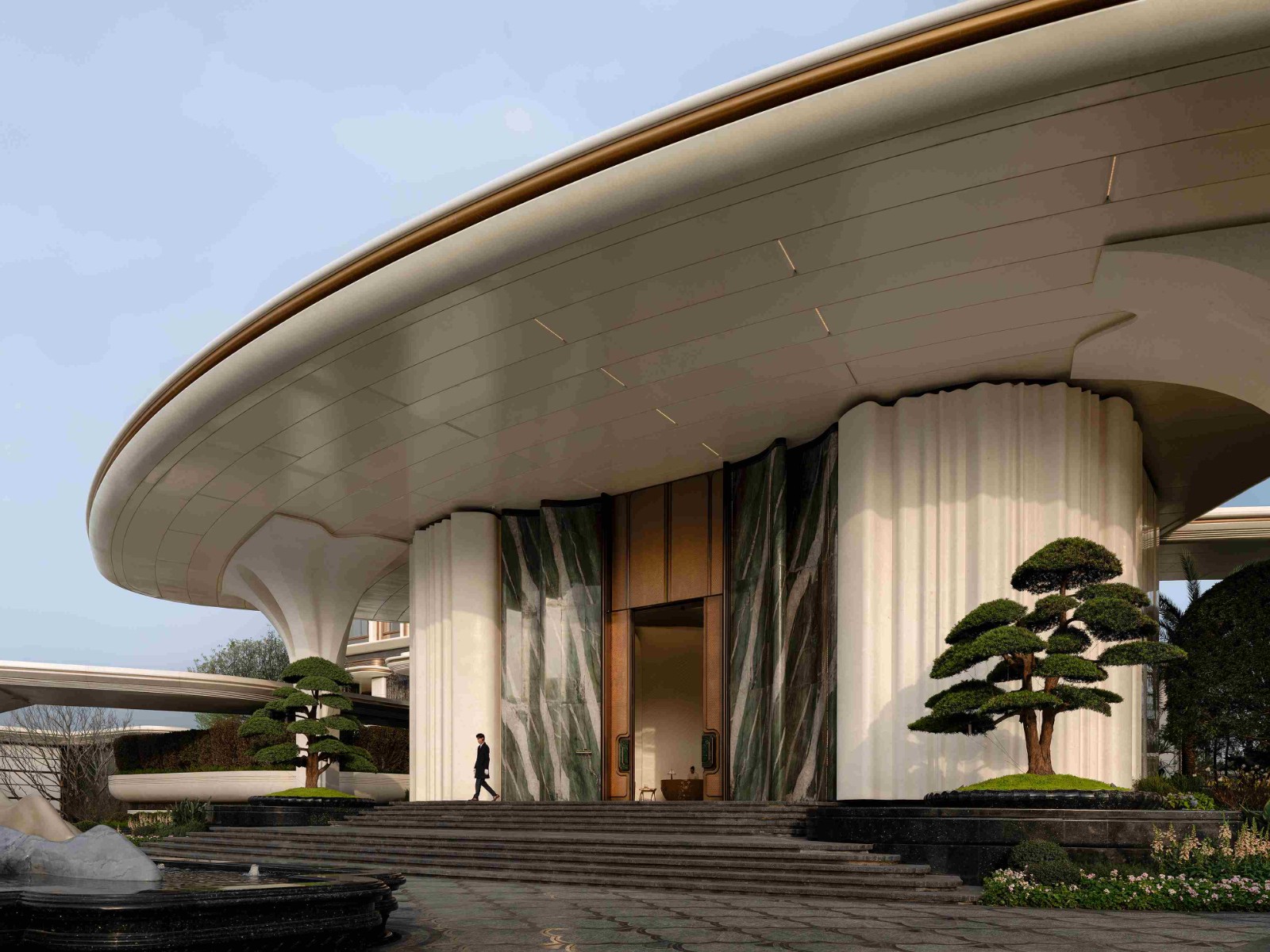
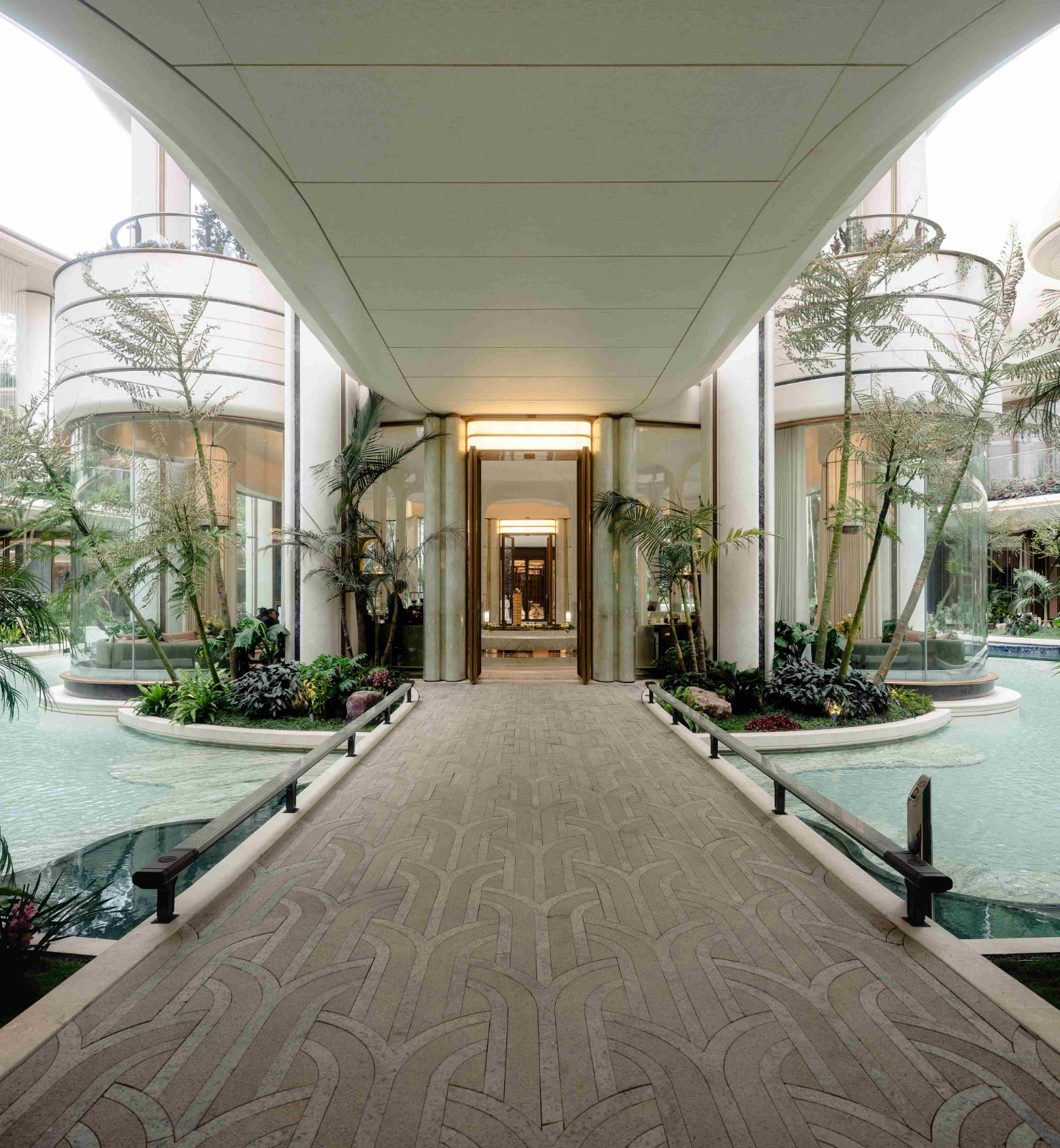
我们在设计中深度融入对成都人文肌理的洞察,将在地文化元素转化为一系列非标准化的定制细节。从入口大门开始,巨大的屋顶和挑高空间带来一种具有庇护感的宏伟,但细部的亲切尺度和自然材料的运用又避免了疏离感。门扇设计尤为精妙:金属拉丝饰面中嵌入了成都非遗“怀远藤编”的编织肌理,辅以芙蓉缠枝纹浮雕与和田玉执手,并配以整块手工打磨的翡翠石材,形成材质、工艺与在地文化的深度对话。
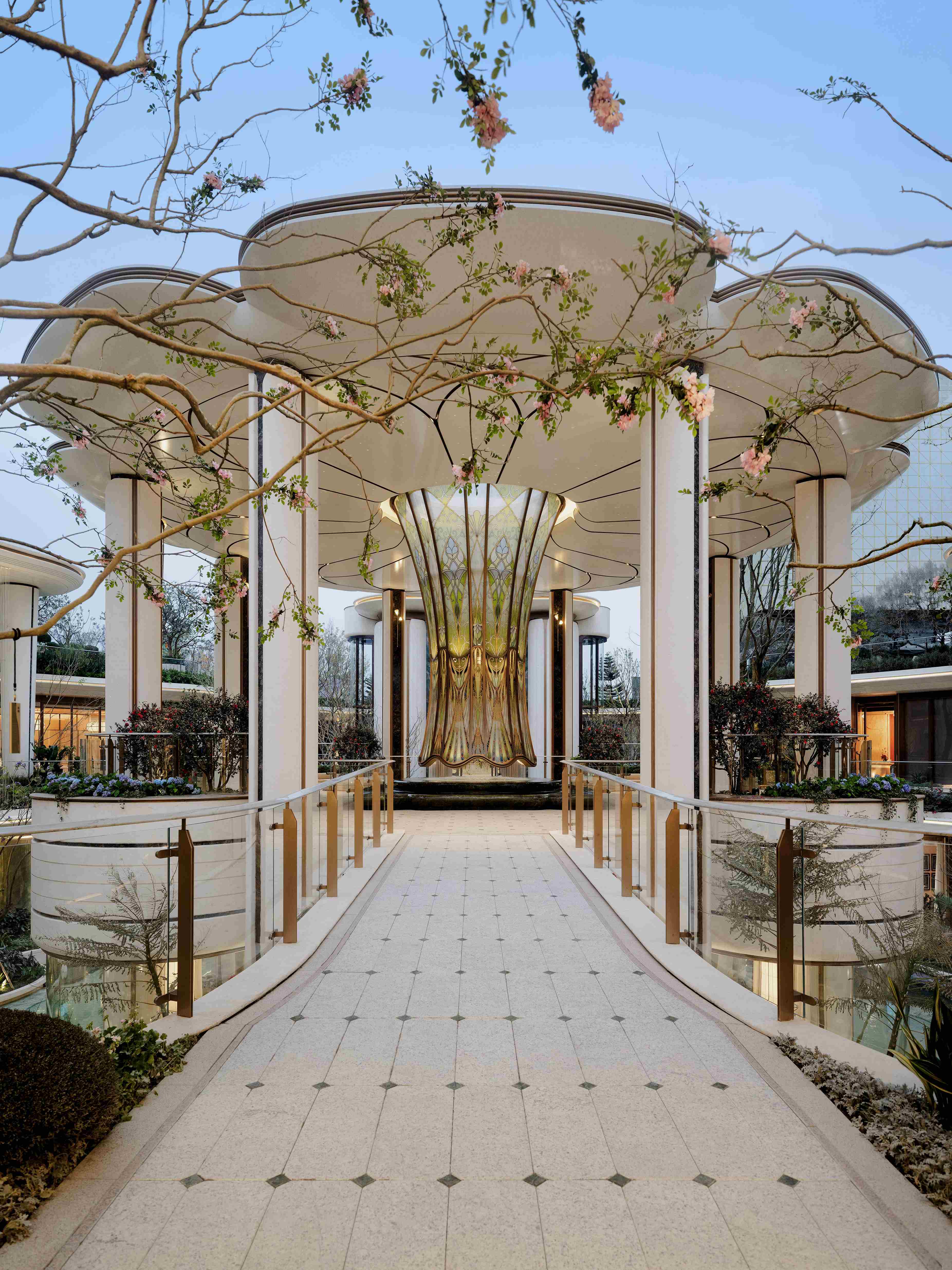
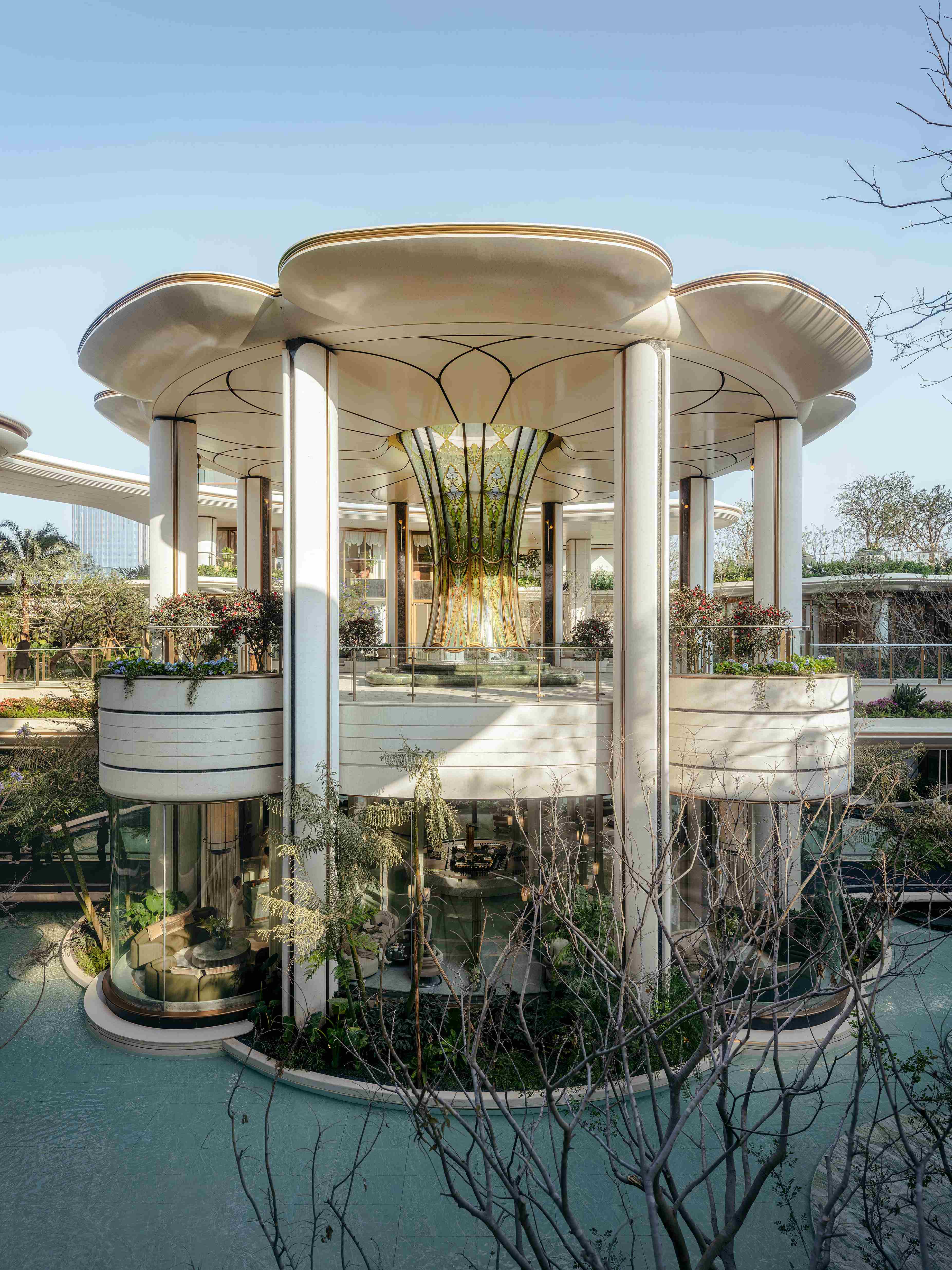
作为空间诗眼的“建木亭”,其造型源自芙蓉花的形态演绎。不规则的空间柱体表面镌刻藤蔓状银丝花纹,象征生生不息的自然生命力。全石材覆层与几何曲面的结合,使构筑物既具雕塑感,又承载着沉浸式的艺术氛围。
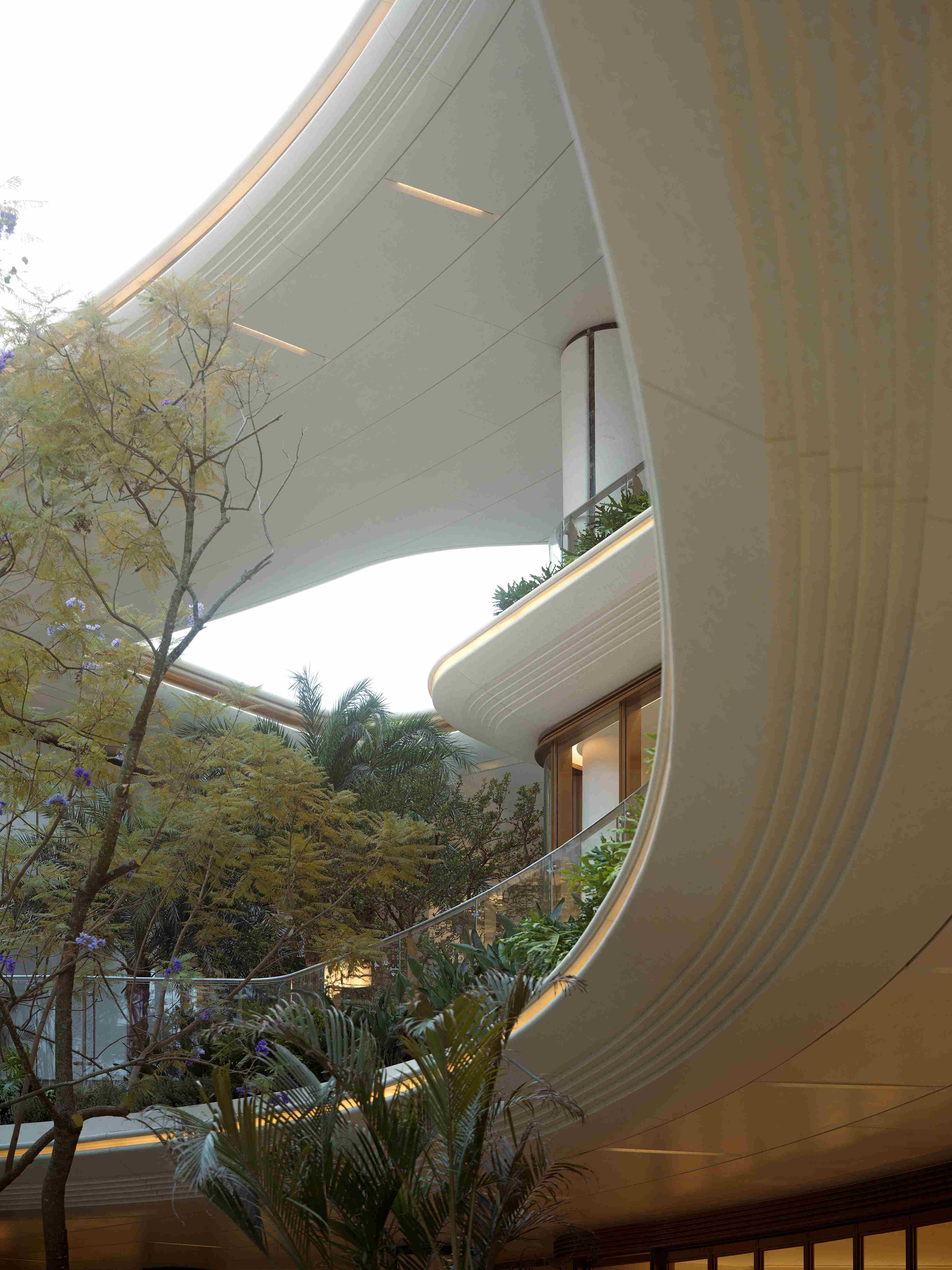
另外,整个项目中最为独特之处在于各类曲面玻璃幕墙的全定制设计,通过反复推敲曲率、比例与构造节点,最大化实现自然光与景观的渗透。这一设计策略不仅拓展了视觉的通达性,更在无形中消弭了室内外界限,使用者在流动的视线中与场域建立起深层的精神共鸣。
The design deeply integrates insights into Chengdu’s humanistic texture, translating local cultural elements into a series of non-standard, customized details. From the very entrance, the monumental roof and generous vertical scale convey a sense of sheltering grandeur, while human-scaled details and the use of natural materials prevent emotional distance.
The entrance doors exemplify this meticulous integration: brushed metal panels embed the woven texture of Huaiyuan rattan weaving, a local intangible cultural heritage, complemented by reliefs of hibiscus scroll motifs, Hetian jade handles, and a monolithic hand-polished jadeite stone. Together, these elements form a layered dialogue among materiality, craftsmanship, and local culture.
Serving as the poetic focal point of the space, the Jianmu Pavilion derives its form from an abstract interpretation of the hibiscus flower. Irregular structural columns are engraved with vine-like silver inlays, symbolizing the vitality of continuous natural growth. The combination of full stone cladding and geometric curvature grants the structure a sculptural presence while sustaining an immersive artistic atmosphere.
Moreover, one of the project’s most distinctive features lies in the fully customized curved glass curtain wall systems. Through repeated refinement of curvature, proportion, and construction detailing, the design maximizes the penetration of natural light and landscape views. This strategy not only extends visual accessibility, but also subtly dissolves interior–exterior boundaries, enabling users to establish a deeper spiritual resonance with the site through continuously flowing sightlines.
项目信息:
项目名称:成都 建发海耀
项目地点:成都锦江区 金融城东
项目类型:住宅
建筑面积:116885.25㎡
建设单位:建发房产
设计时间:2025年04月
建成时间:2025年12月
建筑设计:ZEN正象设计
主持建筑师:柳春玮
主创团队: 方春、唐建安、刘亚飞、杨曦、瞿博
设计团队: 刘晖、周鑫建、岳明、侯赖华、冯建豪、李思蒂、杨嘉强、梁哲伟、赵鑫、徐强 杨建帽
室内设计:仕乾曾(上海)设计咨询有限公司(SCDA)
渡道合维(北京)建筑设计有限公司(孟也工作室)
景观设计:重庆蓝调城市景观规划设计有限公司
主体施工图:基准方中建筑设计股份有限公司
幕墙施工图:中哲创建科技股份有限公司
泰幕工程咨询(杭州)有限公司
建筑摄影:王宁、IN-FIELD studio
